
Colby Carroll
Penrith Anglican College
THIS IS THE DEAD LAND
Collection of Work
Found objects, charcoal, photography, paint
This is the Dead Land is my response to the horrors of the ongoing Russo-Ukrainian War. Inspired by my observations of our ignorance and negligence of the real human suffering that is the consequence of war, my body of work represents the extent of the damage that war inflicts on the body, on the psyche, and on the environment. My intention in combining the familiarity of found objects with the expressiveness of abstract painting was for the audience to have a deep, visceral and emotional response. There is one constant of conflict: war is hell.
My artmaking practice has been influenced by the study and interpretation of the following artists: Anselm Kiefer; Francis Bacon; Robert Klippel; Gerhard Richter; TS Eliot, The Hollow Men [poem].
Marker's Commentary
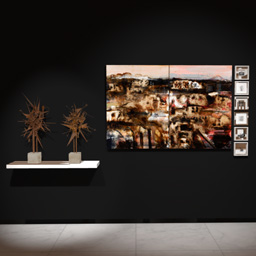
This ambitious body of work explores the trauma and instability of the ongoing war between Ukraine and Russia through a multidisciplinary approach incorporating sculpture, painting, and drawing. Central to the installation are two sculptural works constructed from cardboard, painted like rusted welded steel fragments, appearing frozen mid-explosion. Embedded within and clinging to these fractured forms are miniature soldiers, aeroplanes, and crosses, suggesting both the persistence and fragility of human life in conflict. Figures scramble across rusted, collapsing structures, some inverted or suspended, intensifying a sense of disorientation and precariousness. The sharp steel-like wedges supporting them suggest relentless psychological tension, while the small crosses underscore loss and memorialisation. The sculptural language evokes Cornelia Parker’s Cold Dark Matter: An Exploded View and Anselm Kiefer’s explorations of history and trauma, situating the work within a lineage that confronts violence and trauma. The work contrasts human vulnerability against mechanised destruction, rendering the lived reality of war tangible and visceral. The spherical battlefield and twisted metal landscape suggest a world fundamentally out of joint. This sense of rupture extends into a large two-panel painting, where a heavily textured surface evokes a devastated and abstracted landscape. Charred structures emit dark smoke, while scorched terrain appears almost unrecognisable. Hollowed windows of ruined buildings reinforce themes of absence and abandonment. Subtle apricot tones within the sky hint at both lingering fire and the possibility of renewal.
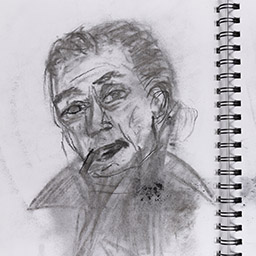
The dense materiality of the painting’s surface suggests earth saturated with conflict, reinforcing the physical weight of destruction. Across the painting, textured surfaces and a restrained palette of bitumen, burnt umbers, ochres with small flashes of red communicate decay alongside resilience. Smaller framed portraits introduce an intimate human dimension, focusing on memory, identity, and loss. Ghost-like figures and anonymous, gaunt soldiers evoke the erasure of individuality, functioning as fragile, spectral presences against the more aggressive sculptural forms. Ultimately, the work raises profound questions about survival, displacement, and the meaning of home, offering a powerful lament for suffering while quietly suggesting endurance and the possibility of healing.