
Charlotte Madison Ford
Pymble Ladies' College
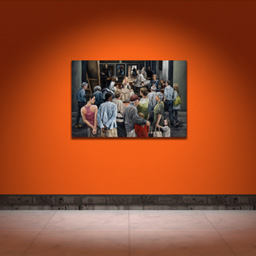
THE WITNESSES (AN ALLEGORY)
Painting
Acrylic on canvas
My body of work investigates the concept of artistic representation and how the roles of the artist, artwork and audience are shaped by sociocultural change and our desire to communicate our ever- changing world. I reference the self-reflexive, meta-artwork Las meninas by Velázquez, which places the artist in the work, to represent a contemporary audience, positioning the audience as participants in the artwork itself. My intention is to create a dynamic conversation about the role of the observer, challenging traditional notions of artistic authority and interpretation that arise when a work is left solely to audience speculation.
My artmaking practice has been influenced by the study and interpretation of the following artists: Diego Velázquez, JC Leyendecker, Arnold Bocklin, Dean Cornwell, Norman Rockwell, Will Rochfort.
Marker's Commentary
This sophisticated and ambitious painting brings together conceptual depth with a refined, confident style, inviting the audience into an active dialogue about their role in the experience of art. Executed with a high level of technical control, the work depicts a contemporary crowd gathered in a gallery, observing Diego Velázquez’s Las Meninas. By uniting this historically significant artwork with present-day subject matter, the artist creates a layered exploration of looking, both at and from within the image. The composition draws directly on Velázquez’s strategies, reimagining the viewer as a participant within the scene. A compelling visual echo appears in the foreground, where a child turns towards the audience with a sideways glance, mirroring the Infanta Margarita’s stance in Las Meninas. This interplay of gazes reinforces the central theme, the oscillation between being the observer and the observed. The painting questions art historical hierarchies, suggesting that meaning is not fixed by the artist alone but emerges through audience engagement.
Rendered in a technically assured, mannerist-influenced style, the work demonstrates a strong command of light, shadow, and form. Flesh and fabric are modelled with sensitivity, as tonal gradations and shifts in value convincingly articulate three-dimensional space. The nuanced treatment of drapery, particularly in the folds of clothing, reveals an understanding of structure and how direction supports composition. Realism is balanced by areas of more fluid, expressive brushwork, which enliven the surface reinforcing the notion that this as a snapshot of a particular moment in time. The diverse array of figures within the gallery contributes to the vitality of the scene, with varied postures and orientations suggesting multiple modes of viewing. These subtle differences animate the composition, transforming it into a living exchange of perspectives. At the centre, the enduring presence of the Infanta Margarita, appropriated from Velázquez’s original, continues to command attention, bridging past and present while reinforcing the timelessness of the act of looking. Ultimately, this work functions as both a tribute and a critical inquiry. By recontextualising Las Meninas for a contemporary audience, the artist has created a visually engaging and intellectually sophisticated work that explores changing interactions between artist, artwork, and audience.